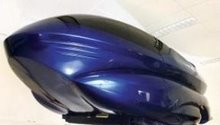
An all-electric aircraft could soon appear over the horizon thanks to high-flying scientific research published today in the Institute of Physics' journal, Superconductor Science and Technology. The new type of aircraft, currently on the drawing board, could be far more efficient than conventional aircraft, produce less greenhouse emissions, and be quieter.
Air travel is on the increase, but it comes at a price in terms of the emissions driving climate change. Aircraft currently account for about 5% of UK emissions with a single long-haul flight the equivalent of a ton of carbon dioxide per passenger. With such worrying figures making the headlines, alternatives to combustion-based propulsion systems could be the key.
Superconducting motors could be one such alternative, according to scientists in America. Philippe Masson and Cesar Luongo from Florida State University, who have collaborated with Gerald Brown at NASA and Danielle Soban at Georgia Institute of Technology, explain that because superconductors lose no energy through electrical resistance, they could be very efficient components for a new type of aircraft propulsion.
The researchers explain that to build an electric aircraft will require propulsion motors that are high power, lightweight and compact. Current technology cannot meet these demands because an electric motor using conventional magnets can weigh up to five times as much as conventional jet engine and not be as fuel efficient.
In contrast, a superconducting motor would be very lightweight and far more efficient electrically, generating three times the torque of a conventional electric motor for the same energy input and weight. In addition, an electric aircraft would be far quieter than a conventional jet as there are no internal combustion processes involved. It is the combustion of fossil fuels to drive a conventional aircraft that makes them so noisy.
However, superconducting magnets not only have to be cold, but require a unique energy supply. Masson and his colleagues believe they could solve both problems by using chilly liquid hydrogen to run an electric fuel cell. Liquid hydrogen is cold enough to make the superconducting magnets work but also has four times as much energy weight for weight than aviation fuel.
A fuel cell produces no polluting emissions, just warm water as the hydrogen combines with oxygen. This, say the researchers would mean zero carbon emissions from the aircraft as it flies. "The idea is to reduce the emissions from the aircraft and airports," explains team leader Masson, "The energy needed to produce the liquid hydrogen could come from a remote powerplant". Such a powerplant might be solar or wind powered.
"We could potentially build a superconducting motor and generator smaller than a gas turbine, which would make possible electric propulsion," says Masson. Electrical propulsion would not only decrease emissions but also reduce to a minimum the needs for maintenance as all hydraulic systems would be eliminated, he adds. The team has designed such systems with high fidelity models and optimization tools.
Masson adds that the team is now looking for an industrial partner to build a prototype of the superconducting "turbofan". "The technology is there," he says, "it is a matter of finding a source of funding."
Original Source: Institute of Physics, News
________________________________________________________
________________________________________________________
Sunday, 24 June 2007
Monday, 21 May 2007
Magnetic Sails Deployed

Some day fleets of interplanetary craft powered by the solar wind may cross the Solar System, using huge magnetic fields as their ’sails.’
Image: Artist’s impression of a mini-magnetosphere deployed around a spacecraft. Credit: Robert Winglee/University of Washington.
The concept is increasingly well understood, and researchers like Robert Winglee (University of Washington) have been extending it to include beamed propulsion methods as well.
Winglee’s concept is called MagBeam, useful if your goal is to move deeper still into nearby space. But for all this to happen, we’ll need to learn much more about the solar wind itself and how we might ride it.
Plasma or ionized gas is trapped on the magnetic field lines generated onboard, and this plasma inflates the magnetic field much like hot air inflates a balloon. The mini-magnetosphere is then blown by the plasma wind from the Sun called the solar wind which has a speed of between about 350 to 800 km/s.
Enter NASA’s Solar Wind Experiment, flying aboard the Wind spacecraft launched in 1994, and designed to study such things as the stream of electrically charged particles constantly produced by the Sun.
The Solar Wind Experiment can measure the speed, density and temperature of those particles. And it turns out to be particularly well placed for such work, according to John Steinberg from Los Alamos National Laboratory: “We study the solar wind for practical reasons; the character of the solar wind blowing by Earth at any time determines conditions in the near-Earth space environmen.
It turned out that the Wind Solar Wind Experiment data were ideal for this particular study because of continuous data coverage that the spacecraft provided during the previous solar activity cycle minimum in 1996, through the recent solar max in 2001, and into the solar activity declining phase afterward.”
A key part of the analysis is to understand how the solar wind is accelerated to speeds between 600,000 and one million miles per hour. And it turns out that helium is implicated in the result. Most of the material in the solar corona is hydrogen, but as the hydrogen escapes the corona, it drags some heavier helium along with it, in the process slowing down.
But the huge events called coronal mass ejections show five to ten times the amount of helium normally found in the solar wind. Evidently helium building up in the solar atmosphere is suddenly expelled during these events. When the solar wind is at lower speeds, it is made up primarily of hydrogen, with little helium observed. Thus we have a lower speed limit established by the retardant effects of helium, with the coronal mass ejections showing what happens periodically to the helium that remains.
Helium: Speed Brake for the Solar Wind? from Centauri Dreams
________________________________________________________
________________________________________________________

Thursday, 19 April 2007
Starship: Plasma Shields
 Shields For Starships: A Reality?
To protect the occupants from the potentially lethal radiation in space from the Sun, a superconducting ring on board the space craft could produce a magnetic field, or mini-magnetosphere, similar to the Earth's, which would create a 'deflector or plasma shield'.
(Credit: Image courtesy of Royal Astronomical Society)
Cosmic rays and radiation from the Sun itself can cause acute radiation sickness in astronauts and even death. Between 1968 and 1973, the Apollo astronauts going to the moon were only in space for about 10 days at a time and were simply lucky not to have been in space during a major eruption on the sun that would have flooded their spacecraft with deadly radiation. In retrospect Neil Armstrong’s ‘one small step for Man’ would have looked very different if it had.
On the International Space Station there is a special thick-walled room to which the astronauts have had to retreat during times of increased solar radiation. However on longer missions the astronauts cannot live within shielded rooms, since such shielding would add significantly to the mass of the spacecraft, making them much more expensive and difficult to launch. It is also now known that the ‘drip-drip’ of even lower levels of radiation can be as dangerous as acute bursts from the sun.
On the surface of the Earth we are protected from radiation by the thick layers of the atmosphere. And the terrestrial magnetic field extends far into space, acting as a natural ‘force field’ to further protect our planet and deflecting the worst of the energetic particles from the Sun by creating a ‘plasma barrier’.
Now scientists at the Rutherford Appleton Laboratory in Oxfordshire plan to mimic nature. They will build a miniature magnetosphere in a laboratory to see if a deflector shield can be used to protect humans living on space craft and in bases on the Moon or Mars.
In order to work, an artificial mini-magnetosphere on a space craft will need to utilise many cutting edge technologies, such as superconductors and the magnetic confinement techniques used in nuclear fusion.
Thus science is following science fiction once again. The writers of Star Trek realised that any space craft containing humans would need protection from the hazardous effects of cosmic radiation. They envisioned a ‘deflector shield’ spreading out from the Starship Enterprise that the radiation would bounce off. These experiments will help to establish whether this idea could one day become a practical real.
_______________________________________________________
_______________________________________________________
Astronomers Map Out Planetary Danger Zone
Astronomers Make Detailed Image Of Giant Stellar Nursery
Hubble Space Telescope Reveals The Aftermath Of 'Star Wars'
_______________________________________________________
_______________________________________________________
Sunday, 15 April 2007
Where is The Proton?

Scientists Discover Footprints Of Shared Protons
This week in Science, Yale researchers present "roadmaps" showing that shared protons, a common loose link between two biological molecules, simply vibrate between the molecules as a local oscillator, rather than intimately entangling with the molecular vibrations of the attached molecules.
The paper reports clear "roadmaps" for the widely varying, characteristic vibrational frequencies that occur when an excess proton binds together simple nitrogen and oxygen containing molecules.
Rather than studying the proton-trapped pairs of molecules in crystals or in solution at room temperature, as has been common in the past, Johnson's team made their measurements of proton interactions with 18 simple molecules by isolating them in the gas-phase and cooling them to about 50 Kelvin by taking advantage of recent advances in argon nanomatrix spectroscopy.
"Historically it has been very difficult to isolate the signature of an excess proton in a complex environment like a cell membrane, and say with confidence 'Aha, I have one,'" said Johnson. "The proton is in constant motion in a warm, disordered medium, which causes its natural vibrational frequency to spread out over a huge spectral range. As a result, its 'signature' is often thought to comprise the continuous 'junk' background in the vibrational spectra of protonated samples."
"When we cool the isolated systems, the protons sing out their sharp vibrational frequencies, and therefore provide clear signatures that are characteristic of each kind of interaction," said Johnson.

Two oxygen atoms on different molecules are connected by their mutual attraction to an extra proton, shown as a fuzzy ball between them. The presence of such intermolecular binding can now be identified by monitoring the precise vibrational frequency of the bridging proton. (Credit: Image courtesy of Yale University)
The research shows that the extra proton is associated with a specific pair of atoms on the two tethered molecules, participating in partial chemical bonds to both. "In biological systems, any time you have molecules with a nitrogen or oxygen, and add in an extra proton, the proton forms a bond with one of the extra electron pairs that are available," according Johnson. "It crashes the party and changes the character of the molecule."
Extending Johnson's analogy, if another molecule containing nitrogen or oxygen comes by, the proton crashes that party, too. Because the proton is not deciding between one molecule and the other, it is creating a bond between them - crashing both parties at the same time. "A proton is a great handshaker that works the room until it gets to where it is needed," he said.
This motif is the generic intermediate involved in passing a proton through a biological membrane. Each paired interaction forms a locally stable intermediate. In a sense, the oxygen atoms in water molecules chaperone protons between oxygen and nitrogen atoms on organic structures. For example, the primary events in trans-membrane proton pumps require passing protons through many relay steps across the cell membrane.
In earlier studies, Johnson looked only at water molecules trapping protons. This study expands the work to biologically relevant molecules that contain oxygen and nitrogen atoms. In it the researchers were able to look at how stiff the proton trap is between two molecules, and how this stiffness depends on the properties of the molecules to which the protons are attached.
"The strength with which the proton is grabbed by a nitrogen - or oxygen- containing molecule is highly affected by the environment," said Johnson. "So, we systematically changed that environment over a huge range and followed how the localization of the proton changed. We found that the way the proton is localized depends very much on the chemical properties of the atoms you are trapping it with."
_____________________________________________________
_____________________________________________________
Mew NMR Methods by Kurt W Zilm
LUMO Analogy among three fluorides
Argon Nanomatrix Spectroscopy by Mark A Johnson
______________________________________________________
______________________________________________________
Friday, 30 March 2007
Possible Worlds

Possible Worlds by ThinkingThing
When looking at the inmensity of Space we are left in no doubt of its vastness. When we look at earth we see on its surface the rivers and roads, the highways and railways, the ringroads and tunnels that link us across the world. The airports and skyways that exist on the surface of this globe.
This is only the beginning of The New Age.
A New Dawn is upon us, where the distances and dimensions we travel through grow and expand beyond the horizon.
______________________________________________________
______________________________________________________
Subscribe to:
Posts (Atom)